The Binding of Fenris
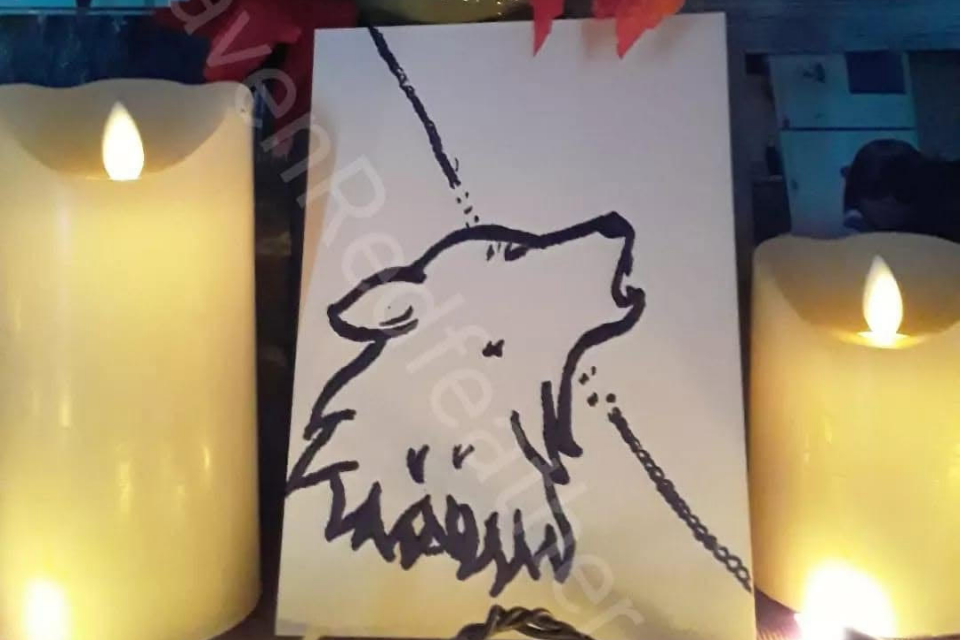
You find yourself in a deep wood with old, ancient and knotted trees, their roots often sticking out of the ground creating seemingly hazardous pathways through the thick forest. The almost musty smell of earth is all around. The aroma of moss, lichen and decaying undergrowth fill the air. There are many creatures here, we call them creatures because there is no one form to them. Many of them change appearance and shape as they walk down the rooted pathways. Many limbs, few limbs, some with no limbs at all are carried by others. Some appear almost tree-like while others crawl merely inches off the ground. Their eyes, when you can find them, are piercingly strong. You are not threatened but intrigued. No two creatures appear the same but there is a sensation of kinship among them.
This is the Ironwood, the living, beating magical heart of Jotunheim. Here nine clans live somehow both in conflict and in peace. The chieftess among all nine tribes is Angrboda, the leader of the wolf clan. Her consort, Loki, comes and goes between these dark and magical woods and the world of tall, shining towers, swords of metal and the Gods known by man as the Aesir. These worlds are vastly different, even more so than the differences in the creatures walking in the twisted Ironwoods.
Angrboda resides in a hut-like home with a small garden and inside that garden her three children play. The first is a daughter, her beauty striking though her body somehow shifts before your eyes. Maggots crawl out of decomposing bits of flesh, giving away to bone. Regrowing back again in a nonstop flow of decomposition and regeneration. This is Hela or Hel. She is calm, collected and very aware of your attention in the story. Laying on the ground near her is a snake. Long and winding around itself, the snake says nothing. This is Jormungandr. The world serpent. Pouncing around the yard is a hyper, young wolf pup. Jet black fur and beaming, bright yellow eyes. The very tip of a fang pokes up from behind his upper lip. He seems happy, chasing some pretend foe, or perhaps an invisible one. This is Fenris and he, with his siblings, lives with their mother. Their father, Loki, travels between this home and another. Neither the mother or father are seen and the children seen safe and happy enough. The pup continues to play, the young girl keeps staring at you and the snake... has somehow grown noticeably in size. A shadow of sadness falls upon the scene.
You sense the presence of others somewhere in the knotted woods, felt but unseen. For the first time, the girl looks away from you. She senses them as well. Swiftly, three strong men come rushing out of the wood. One grabs the snake, shoving it into a sack and tying it tightly closed. A second rushes to grab the wolf pup and is met with teeth sinking shallowly into his flesh. The man yells out in pain but is able to swat the pup away, the pup’s head smacking off of a nearby tree. Quickly the man ties a leash around the stunned pup’s neck and drags him off. The third man simply takes the girl by her wrist and with one harsh tug, she follows.
As the pup’s senses come back to him, he begins to snarl and fight. He dodges yet another blow from the strong man but is unable to see the kick from the man carrying the sack containing his sibling. The kick sends him flying but the leash tugs him back and his body slams into the ground. Again stunned, the men struggle to roughly muzzle him but do so and continue on. They walk on for what feels like days. Through trees, brush, field and stream. Paw and foot sore, they continue without stopping. Day and night muddling into one another, the young wolf has no sense of time. The snake wriggling in its sack, clearly outgrowing his prison. The wolf pup fighting and being yanked on, unable to do more than jerk at his rope leash and be yanked back or kicked down and dragged. The pup never gives up fighting. He takes breaks, walking along tiredly, but he keeps fighting when he regains some strength. The girl keeps walking calmly and wordlessly. All six of them are clearly travel-worn when they finally make it to their destination.
The wolf pup sees the highwall surrounding Asgard, the golden topped towers, many buildings with white stone walls…. Very little trees and…. lots and lots of people. He is tired, his paws sore, he is thirsty and his tongue is dry. He is comforted seeing his sister nearby. The three are brought to Odin, the Wise One, who sits upon a throne in a much too fancy hall, at least too fancy for Fenris. The wolf pup dislikes the feeling of the marble floor under his paws and the echoey sound of the men’s boots as they march up to the front of the room. As he sees people more clearly, the Gods of Asgard are waiting for him; they look so much alike, he thinks to himself. Their hair is different shades or lengths but they all have hair. They all stand on two legs and have two arms. They’re all the same general shape and roughly the same size. He has never seen such conformity before. He heard tales of Asgardians from his father Loki, when he came back to visit. He never imagined anything like this. Why was he here? His mind wandered in his exhaustion. More than anything, in that moment, he was thankful to sit. Thankful that his siblings are still with him.
Seated on a throne, Odin awaits wordlessly. Forward comes the man carrying the sack, now bursting at the seams. The snake is spilt out onto the cold, hard floor. Hissing, it gets its bearings and aims to strike at its captor. “Throw it in the sea surrounding Midgard,” Odin declares without a pause, slightly distracting the snake. Straight away, a new snack is used to grab the snake, hissing and wriggling violently. The pup gets up now; his right forepaw hurts him and he winces. His captor yanks at his leash causing him to limp back a step. He tries to yelp as his sibling is carried off but the pup is clearly outpowered and can do nothing as he watches his sibling taken out of his sight... His sister is then brought before Odin and the Gods gathered around gasp in horror, some turning their faces away from her in disgust. She coolly walks up and faces the Wise One. Staring him blankly in his one eye. Odin pauses, waiting for the murmurs from the crowd to die down. “Take her to the furthest reaches of Nefilheim,” he declares. Hela turns around as if knowing where to go. Her brother again goes to get up and she looks at him. He stops and you wonder if they are communicating somehow. With his attention on his sister, the young pup still notices that the man on the throne seems annoyed.
“She will rule over the dead!” Odin shouts as she walks out with her captor turned escort. The pup is angry now, his hackles rise as he is brought before Odin. Where will he be sent? he wonders. Can he escape? What will they do to him? He begins to snarl and Odin begins to speak but is cut off — “I will raise the wolf!” a man steps out from among the Gods. The man is tall and muscular. Neatly trimmed hair with slight but noticeable grey streaks beginning to appear. He approaches the throne and speaks in hushed whispers with the wise one. After some conversion, Odin agrees and speaks out: “Tyr will raise the wolf pup” and some small gasps arise from the crowd as they begin to murmur to one another. Tyr takes Fenris by his leash, and, when at Tyr’s home, removes his muzzle. A deep dish of fresh meat is placed before the young wolf but he does not eat. Untrusting, his piercing yellow eye never leaves Tyr’s. Tyr encourages him to eat, and, overcome from his long travel, he eventually does.
Fenris lives with Tyr and is treated well by him. He is fed good food and never lacks a need, but is also never allowed to leave Tyr’s home unfettered or alone. Tyr is kind to him from the very start and a kinship quickly grows between the two. Tyr does not hide Fenris’s life from him and is honest. Fenris is told that the Gods fear him and his family, their strength and power, and that he may not be freed yet. Fenris does not like this but accepts it for the time being, he is still young and cannot outpower the Gods of Asgard anyway. Time goes on and the love and kinship between Tyr and Fenris grows. Tyr acts as Fenris’s father figure and Fenris learns from him. Fenris too grows quickly and soon no leash could possibly restrain him. Still, he allows Tyr to place a leash upon him. He is proud of his strength and often gets to watch matches between the Gods as they wrestle or fight. He learns quickly that brute strength is valued among these Gods, more so than cunning or healing skill, more so than magical power which is feared but accepted. Brute strength is the currency of power here. He is never permitted to show aggression or show off his own strength, not in public. Tyr wrestles with him in private training sessions, teaching Fenris while also giving him an outlet for his strength. Often when Tyr takes him out, he looks for his father, Loki, but oddly he is never found. He never asks Tyr where Loki is either.
Fenris grows stronger and Tyr trains him in battle, in hunting. He begins to take him outside the walls of Asgard and unleashes him. They play sporting games, they hunt. At times they sleep and camp out there beyond the wall, under the stars. This is Fenris’s favorite time with Tyr; camping and hunting in the wilderness beyond the walls of Asgard. Free from the judgmental eyes, free from his leash, free to run as fast as he wishes and eat equally fast. Free. Slowly, the sense of freedom beyond the walls grows on Fenris and he does not wish to return to the leash. He begins to fight even Tyr and easily breaks any leash placed upon him. The Gods and servants of Asgard fear Fenris and his strength. While they admire brute force on others, it is a source of discomfort when displayed by the Jotun wolf. Never since he was brought here did anyone other than Tyr offer him food, or kindness, or even to play with him. When Tyr would walk past with Fenris, the children were taken inside. Fenris thought about this at late night under the stars while camping. He wasn't permitted to leave, but he wasn't accepted to join. Fenris often overhears Tyr being scolded for bringing him around. “Perhaps that’s why we’ve begun to leave the walls” Fenris thinks to himself. Fenris can no longer be called a pup and his yearning for his kin grows. Many times he leaves Tyr’s home without his escort, simply walking the streets of Asgard alone. No one dares approach him, but Tyr is always sent to retrieve the wolf. Tyr takes Fenris out beyond the walls more often and one evening by the campfire, Tyr stoically asks “Do you wish to stay here?” Fenris ripping apart the boar he had caught earlier looks up, blood dripping down from his chin. Licking at his lips, he looks inquisitively at Tyr. Tyr does not joke and has never lied to him. Fenris notices that there is a sadness to his stepfather’s voice. “You can stay in these forests, if you promise to not hunt Asgardians.” Tyr eventually speaks up, and Fenris agrees. He does not wish to be leashed or fettered.
And there Fenris lives for some seasons. Tyr often comes to visit and share meals with him. They talk but the conversations slowly turn one-sided and brief. Tyr can tell that Fenris is growing cold of heart, but what else can Tyr do? He has lived in Asgard under the rule of Odin for most of his adult life. These are his people, he is sworn to them. He cares for Fenris and worries for him too. The wolf grows stronger, a natural hunter. Being the massive predator he was, he naturally kept the abundance of wildlife at bay making hunting far more difficult for the Gods living within the walls. Fenris comes and goes, of his own choice, traveling the wilds for sometime. No matter what though, he always returns. He remembers his former home and even visited once or twice, but he was raised by Tyr and while he'll never admit it, he considers Asgard home. So even after travels, he returns to the woods near Asgard and lives independently, hunting, sleeping and running in the woods. Tyr was often blamed for victorless hunts and servants punished for empty larders when Fenris’s appetite was larger than the available prey. Tyr took the brunt of the God’s dislike of Fenris and never spoke of it. Fenris never knew how Tyr suffered. Tyr pleaded with Odin to aid Fenris, asking him to encourage the others to be kinder to the great wolf. Odin would not hear of it, Fenris was a monster of a jotun- and jotun are already monsters, or at least they’re called so in Asgard. Odin’s word is always obeyed.
As Fenris grew his anger at the injustices he suffered grew with him. He was maturing now, coming of age. His lust for, well, for lust, was kicking in and his natural desire to breed was becoming louder than his hunger for acceptance. His anger for the lack of his acceptance from his own captors festered in him. He traveled away for longer periods of time and those living in Asgard enjoyed his presence being gone, except for Odin. Odin never spoke of why he allowed Tyr to raise Fenris, and Tyr never told anyone what his argument for it was, but Odin was growing more wary of the now mighty wolf. He did not like Fenris being where his warriors were not. But even Odin cannot overpower nature's inclinations and Fenrir did eventually sire offspring. Even still, the great wolf desired the type of family he saw in Asgard. The trouble of raising a Jotun in Asgard, and never accepting them, is that you teach them a bond they’ll never have. Fenris wanted the bond he saw families in Asgard have; not having a bond with his own family — torn apart by the Gods of Asgard. He yearned for the bond he did see, one he never experienced, not even when he returned to Jotunheim. Jotun loved their families, but the bond was vastly different from what he was raised watching.
Seeking the acceptance of them, he returned to the woods around Asguard and was met by a council of Gods at the edge of the forest. Some scared, others angry, all wanting him to leave, except for Tyr. Tyr seemed rigid and uncomfortable being there. Fenris looked around confused, these Gods have never confronted him before. “Why are you here?!” calls out a woman's voice. Murmurs of agreement ring out. “Leave, wolf,” calls out Thor, visibly larger than the rest, “you have no business here.” Fenris pauses. “This is my home,” he replies, “you brought me here.” Shouts of him to leave, to return to Jotunheim, jeers and boos ring out. The woman steps forward and when Fenris steps closer to her, she does not back up. Her hair is long, red and flowing down her back. Even Fenris acknowledges her stunning beauty. She wears a strikingly beautiful necklace made of Amber and is not afraid of the wolf, not in the slightest. “Why are you here?” she asks him again, not a drop of fear or hesitation in her voice. Fenris snorts at the question. “What do you want of us?” the Goddess asks. Fenris can only think of how he grew up, taken from his home and forced to live in this world so different from his own. Always an outcast, never making friends, never playing with anyone other than Tyr. Always trying to be strong like Thor, swift like Freyr, diligent like Heimdal or noble like Tyr. Always trying to fit in with his forced kin. Agitated, the wolf looks up at the beautiful Goddess. “I seek your love,” he says to the crowd. The woman smirks, then sighs. Thor rolls his eyes. Tyr keeps his eyes to the ground and the crowd snickers at the strong wolf asking to be loved. The wolf paces then. “I seek your acceptance!” he cries out. The crowd gives him the same reaction. “We refuse it. You do not belong here,” the woman replies as she turns away from him. “And you never will” she says walking away, the Gods blocking Fenris from her path. The dark reality sets deep inside of the great wolf, “you never will” ringing in his head. He stands in silence, the festering anger consuming him. The crowd leaves and Tyr walks up to his not-so-little pup. The two sit in silence.
Over the following weeks, Fenris grows colder and angrier. When he gets too close to the wall of Asgard, rocks or even spears are thrown his way. Still, he desires to be accepted by the Gods of Asgard, the Gods he knew growing up. One early winters day a group of servants are out hunting the same prey Fenris hunts. Upon seeing the wolf, they aim their arrows at him. The tiny arrows bounce off his hide and the angry Fenris changes his plan, and he hunts the servants of the Gods of Asgard and grows a taste for their flesh. That winter, he began to dine on them exclusively. The thought of his former captors and those so cruel to them having to fetch their own dinner delighted Fenris in his hunt.
Eventually the Gods grow tired of Fenris’s appetite and they seek Odin's permission to permanently bind the wolf. Odin grants it. They try to fetter him and he breaks the chains, they try again and just as easily he breaks them again. They seek out the dwarves and, using deception and magic, they forge a chain that cannot be broken with the strength of man or beast. With Tyr in the lead, the God’s approach Fenris with this thin, little chain. At first he thinks it is a joke but he senses magic and he can sense Tyr’s malcontent. Tyr, the man who raised him. The man who never once lied to him, who fed him, hushed him to sleep when he first arrived, trained him when he was older… that man now came to him with a magical chain and asked Fenris to be bound. Unsure if he believed his stepfather would actually lie to him, Fenris allowed the Gods to place the magical chain upon him so long as one of them placed their hand in his mouth. Tyr agreed, never once looking away from his stepson’s eyes. The hand that often fed Fenris then was bitten off when the deception became evident. The magical chain took hold and tightened around Fenris’s neck and he bit down on Tyr’s sword hand. Blood poured from Tyr’s arm and neither Tyr nor Fenris made a sound. The Gods cheered, kicked, stabbed and mocked the wolf. They threw rocks and boulders at the wolf. They thrust a great sword through his muzzle, piercing his mouth and still his eyes never left that of his stepfather. No pain they could inflict on him could hurt worse than the betrayal from Tyr. Tyr felt it too.
The Gods dragged the bloody Fenris off to frozen Nefilheim into a deep cave and latched his magical fetter into a rock. There, with the sword still thrust into his muzzle, he sits in torment and pain. Left to fester in his all consuming rage until a time when all bounds are broken. His hate of Tyr’s betrayal subsiding with time as Fenris began to understand one truth about the Gods of Asguard: ODins word is always obeyed. Fenris now understands that Tyr had no say so in the matter and all of his hate and rage is aimed at their one-eyed king. Tyr visits him, on occasion, and the two still have a deep kinship and love for one another.
Fenris is trapped in his torment, punished for a crime he did not yet commit. A crime he is pushed to commit. An action he now fantasizes about, and lusts for. An act some feel is justified while others entirely fear. For countless ages, eons, Fenris lays trapped in this cave, in pain and anguish, lustfully waiting for his rage to be set free.
“How fare the gods? How fare the elves?
All Jotunheim groans, the gods are at council;
Loud roar the dwarfs by the doors of stone,
The masters of the rocks: would you know yet more?
Now Garm howls loud before Gnipahellir,
The fetters will burst, and the wolf run free
Much do I know, and more can see
Of the fate of the gods, the mighty in fight.
From the east comes Hrym with shield held high;
In giant-wrath does the serpent writhe;
O'er the waves he twists, and the tawny eagle
Gnaws corpses screaming; Naglfar is loose.
O'er the sea from the north there sails a ship
With the people of Hel, at the helm stands Loki;
After the wolf do wild men follow,
And with them the brother of Byleist goes.
Surt fares from the south with the scourge of branches,
The sun of the battle-gods shone from his sword;
The crags are sundered, the giant-women sink,
The dead throng Hel-way, and heaven is cloven.
Now comes to Hlin yet another hurt,
When Othin fares to fight with the wolf,
And Beli's fair slayer seeks out Surt,
For there must fall the joy of Frigg.”
— Voluspo 48-53