Can the Runes Be Binary? Thought on Ingwaz and Berkana

Over the course of June, I had the opportunity to put into words the runic concepts I’ve had in my head with regards to the runs Ingwaz and Berkana of the elder futhark. These are commonly known as the masculine and feminine runes. I was offering rune readings during a couple of events, throughout June and hence pride. As an inclusive organization and the primary designated, public safe space for magical workings, I had a good bit of non-traditional persons come to me for readings. As part of our large Midsummer Pride celebration, I gave numerous readings within that setting and both Ingwaz and Berkana came up a lot; they were very active runes, which gave me the ability to vocalize the importance of these energies outside of the binary. And I have a LOT to say about how the binary system of projective and receptive energies is misunderstood.
I start off by being very clear, I am a cis-gendered, binary, heterosexual woman who was assigned female at birth. I am not a mouth piece for any communities other than the thoughts that fill my head. I am not a rune master. I am very comfortable and confident with my runes; I will not use a rune set that is not mine. I believe that the runes are living entities and are not static. Their general themes are theirs, and how they speak within the reading may be slightly fluid. Their willingness to speak to the reader, the reader’s ability to “hear” them and the readers skillset are all vital for a rune reading to function. I am not a Viking nor a historian. I do not replicate the Viking heathens. I use the runes as I was taught and as the runes themselves continue to teach me. Clearly, I am a big fan of personal gnosis.
The following information is what I’ve been taught directly from teachers or by the runes themselves.
Ingwaz is the rune of masculine energy. It’s Frey’s rune, the corn king’s rune, and it represents the nurturing of the harvest.
Berkana is the rune of feminine energy. Its shape is that of the breasts and represents life coming fourth and into fruition. I do not associate Berkana with any specific Deity though within a set reading, it may represent One.
We cannot deny that, at least here in the US, we live in a patriarchal society. We also cannot deny that, due to the oppression and very real hurt which that has caused, a lot of people rebel against anything patriarchal when they are able to get away from oppression, which uses the patriarchal as a tool of harm. Within paganism and the “witchy” world, there are a lot of individuals and groups that place a large focus on the divine feminine. In my experience, a lot of this is a reaction from trauma stemming form oppressive, patriarchal religions with only a divine masculine. To be clear, this is a valid trauma and I will not downplay the harm done within that system.
Because of both the patriarchal society and the reaction to it, wherein many people essentially go full matriarchy, we only promote the binary thought systems without exploring what is between or beyond them. Berkana and Ingwaz are included in that. Even when they were written down in this world for the first time, it was already a binary where, in fact, there was never a binary before. Allow me to explain.
Traditionally, we look at fertility and creation within the binary of the masculine/projective energy, which gives to the feminine/receptive energy — and she creates life. This is a linear process and is not how life works beyond a single snapshot. Yes, (using binary terms) a man and woman can have intercourse, he can ejaculate inside of her and, under specific conditions, a baby may be born. The woman’s body nurtures the baby even after birth with breast milk. This is the human’s reproductive course. The man essentially fertilizes the woman and she does all the work. This has been a method of both joy and oppression within humanity for eons. Runes are not human. These concepts are not runic concepts. To better understand the concepts, I look at other life forms in this world and how we all interact together for our creative process.
Produce. Its growth is fertility and most often it is Goddesses whom are asked to bless the crops. It’s often Goddesses who are called upon in the start of the sowing season. It is often Goddesses who are praised when the plants begin to blossom. That is Berkana. The seeds sprouting, growing and blooming. Those blooms hopefully become viable produce… but that is when Berkana begins to transform into Ingwaz. Ingwaz is a harvest rune. Harvesting the produce means killing the produce but nourishing us. We can Berkana the heck out of fields and grow fields and fields of fertile plants, but they won’t nourish us until we apply the concept of Ingwaz. We harvest the fields, nourish ourselves and in turn are able to bring forth the concepts of Berkana. It’s a cycle that never ends. When a person gives birth, there is a great deal of death involved. The most notable is the placenta. The very organ grown solely to protect and nourish the baby must die in order for the birth to occur. There is a harvest. In many cultures around the world, birth is considered a death. Me personally, I consider it a death in the spirit world as that being passes back through the veil to this side. You cannot have Berkana without Ingwaz or Ingwaz without Berkana not because one causes the other but because they must simultaneously happen in order for the other to occur.
If you look at Ingwaz and Berkana, you can see how they easily form one another and if you keep forming them together, they form the Web of Wyrd, which is our never-ending existence. What we’ve labeled as masculine/projective energy for as long as most historians can remember is not just projective.
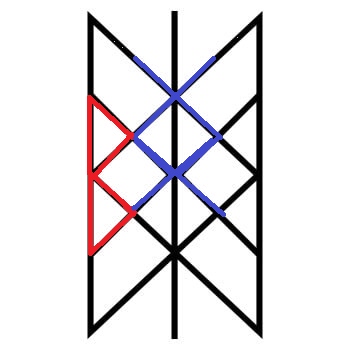
In many pantheons, the Sun is a God and the Moon is a Goddess. In the Norse Lore, this is reversed. The Sun Goddess is Sol and the Moon God is Mani. I was asked about this once — how could the sun be a Goddess and the Moon a God when the Moon receives the Suns energy. Well, we’re nourished from both, and in the far north where the Sun may not rise for long periods of time, the Moon is crucial. Moonlight in the dark of winter was very sustaining in many ways. We receive nourishment from both the sun and the moon. Many plants are believed to grow stronger during direct moonlight. It is a constant transfer of energies. That constant transfer is what makes life and without either, nourishment would not be possible. Without the deemed “masculine” energy of the harvest, we literally would not eat. Without the deemed “feminine” energy of the growth, there would be nothing to harvest. Lately, only feminine energy is deemed nourishing. This is false. Both are nourishing. It’s not a binary, it’s the one and the same. It’s not a coincidence that Ingwaz looks like Gebo, the rune of exchange. Berkana and Ingwaz both nourish via their exchange. That exchange is the nourishment which provides all life.
Explaining this concept in words was something that I struggled with because we have such binary thought processes as a society. Ingwaz, or masculine energy, is just as nourishing as Berkana, or feminine energy. It can even be more nourishing depending on the situation. When an individual from whom I have approval to share this information publicly came to me for a rune reading, we were both a bit perplexed by Berkanan’s insistence to be a key element to his reading. His specific reading had Berkana and Othala (heritage and family) as a key for his situation, however the women within his Othala, his family, were definitely NOT the key. Turns out, he does drag. As soon as I found that out, the reading was crystal clear. His drag family was his key, he needed to rely on them. Berkana isn’t a vagina or a uterus. It’s the creative “pretty” energy of coming forward. Another person — again I have their permission to publicly share this story — came to me for a reading. This time I knew a bit more of their personal life, this individual is a transwoman. When their runes came up as Ingwaz and Hailgaz (destruction) we both laughed. Ingwaz doesn’t necessarily mean a man, or a penis or sperm. It’s the hard work to nourish others and sometimes at a sacrifice to oneself. Harvests are a sacrifice to whatever is being harvested in order to nourish some other life form, typically the life that originally gave it the energy. This is both between and beyond the binary system we use today for sex or gender. It is a circular, or diamond shaped wyrd pattern, that never ends. Even long after our threads are gone, it keeps going and viewing it in a linear fashion or a binary fashion severs off much of that information.
Side note, I don’t believe in gendering any Power based upon it’s energy structure. Sol is a woman because she is identified as one within the Lore and Mani is a man because he is as well. I do not personally believe they are architypes but I respect anyone else’s right to.